Monday, January 4, 2010
Question of the Day: Your Favorite Films of 2007?
20.) 28 Weeks Later
19.) The Simpson's Movie
18.) Knocked Up
17.) Black Snake Moan
16.) The Lookout
15.) Grindhouse
14.) Juno
13.) Atonement
12.) The Darjeeling Limited
11.) Inland Empire
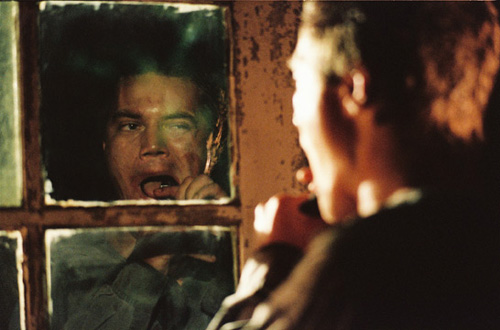
10.) Bug
9.) The Orphanage
8.) Gone Baby Gone
7.) Breach
6.) Into Great Silence
5.) Michael Clayton
4.) Eastern Promises
3.) There Will Be Blood
2.) No Country for Old Men
1.) Zodiac
Friday, October 16, 2009
“I will hate you for doing this, and I don’t want to…”

Ugly, messy, morally ambiguous, and philosophically complex Ben Affleck’s Gone Baby Gone is slowly becoming my favorite film of 2007. I missed its initial run in theaters, and I didn’t catch it until well after I had constructed my top 10 list for 2007 (with the bad ass trifecta of Zodiac, No Country for Old Men, and Eastern Promises as my top three), but I caught the film on DVD when it first came out and loved it, retroactively (in my mind) placed it in my top 5 for that year (because I’m kind of crazy and OCD like that). After watching the film again tonight on Starz I realize that we’re dealing with a masterpiece here. The film is gorgeous to look at (as gorgeous as the slums of Boston can be), and the elder Affleck shows a real command of filmmaking. He frames each shot perfectly, knows precisely when to cut, knows how to set up a scene, and when to change styles; and perhaps most importantly knows when to sit back and let his amazing ensemble cast do the heavy lifting.
More thoughts after the jump...
And heavy lifting it is…by the climax, the film is so interested in letting its two main characters, private investigators (who also happen to be dating) played by Casey Affleck (in a phenomenal performance…watch the way he out-acts Morgan Freeman at the end of this film) and Michelle Monaghan, discuss the moral repercussions of certain decisions, and allowing the audience to decide which side of the philosophical argument they sit, that we’ve pretty much forgotten the complexity of the police procedural that comes before the final moments of the film. The dichotomy that Affleck the director sets up at the end of the film is so much more interesting and taut than a shoot out, or any kind of big “crack-in-the-case” type moment. That’s not a knock on the writing, because the film does a great job of laying it all out there and not drawing attention to any of the clues (only do we know they’re clues when we re-visit the film)…the film respects its audiences intelligence level – and that’s rare for a mainstream thriller.

But that ending…damn I love that ending…executed perfectly by Affleck the director and little brother Casey who has a heart shattering moment with his girlfriend (Monaghan) where the two just don’t see eye to eye on an issue. Watch the way Monaghan poignantly pleas with her partner, stating her case through tears…then watch how Affleck rigidly sticks to his guns despite the pleas from the woman he loves. This is a bigger issue for him than what your significant other wants you to do…this is about what is morally right, and this wrestling with morality isn’t as cut and dry as most Hollywood dramas would have you think.The issue in question (which I won’t spoil too much in case you haven’t seen the movie) changes the lives of four people, and whether it’s for better or worse Affleck and co. leave that for you to decide. Has there ever been a mainstream thriller that’s ended on such an ambiguous note? That final shot sticks with you long after you’ve seen the film (and the final line, too, where Affleck’s character realizes he made a mistake), and perhaps will lead to a heated post-film debate (like the one Affleck and Monaghan engage in at the end of the film) about the decision that is ultimately made, and the limits of morality we are willing to push (or not willing) in order to protect someone from what we may perceive as a bad situation. The film leaves you in a state of contemplation (that final shot is perfect)…contemplating things (and second guessing decisions) that may not be so sunny and neatly wrapped-up; things that may be ugly and ambiguous. Just like life.
Friday, February 1, 2008
Random blurbage on random films...
Mira Nair's film based on the novel by Jhumpa Lahiri is beautiful to look at, but I am afraid it is nothing more than that. I wasn't particularly moved by the film, although I was certain I was seeing something worth investing my emotions in. However, a lot of it just seemed very formulaic and sitcomy. I liked the performances and I liked the early relationship of Gogol (Kal Penn) and his father, and the story about how is parents came from Calcutta to New York City. To me that was the most interesting part of the story, the first hour or so really works, but it falls apart in the third act when Gogol (going by Nick, since he doesn't want to be called by , what he thinks, is a weird first name anymore) seperates from his likeable and understanding girlfriend, and marries an Indian woman in order to make his mother happy. This dynamic is interesting at first as we get some profound commentary on the roles of women in Indian culture, and how Gogol just thinks that his mother would want him to marry "one of their own" as his aunt puts it.
I wish they would have abandoned the relationships problems between Gogol and his new Indian wife and would have explored the deeper emotions and problems that Gogol's mother has with him so easily falling into tradition, when he was so hell-bent on breaking free from it (something she wishes she could have done). To me, the mother is the most interesting character in the film, she is marginalized by her husband (who is compassionate, but upon leaving India for New York City, repeats the mantra to friends and family that "she'll get used to the city") and expected to be nothing more than an Indian woman. Sadly, the story marginalizes her by the end of the film, and where there really could have been an epiphany between mother and son; they opt to have that moment for the not so shocking scene in the car between Gogol and his father, which reveals the origins of Gogol's name.
It's too hit and miss in the third act, and a lot of the emotional oomph is predictable. However, it is still worth seeing for that first hour and the cinematography is beautiful as the great Frederick Elms (he shot one of my favorite films of the 90's The Ice Storm) shoots the film in a washed out almost black and white look and distracts you long enough in the third act to where you are too busy noticing the beautiful filmmaking, to realize you are watching an ending (to an otherwise good movie) with about as much emotional power as a Lifetime movie.
The Bourne Ultimatum
Well, this is my least favorite of the three. It has its moments (like the extended car chase where not a word of dialogue is spoken, that was awesome) and some good performances (once again Matt Damon does a lot with so little and adding David Strathairn to the mix only helped) but overall I was glad the series was coming to a close. I got my fill of Jason Bourne at about the half way mark of the second film, also directed by Paul Greengrass (and scripted by Michael Clayton director Tony Gilroy), which frustrated me beyond belief because not only could I not keep up with the action, I couldn't understand why they were fighting. The camera work in this film is much like the second, so shaky and so feverish that I just wanted to slow it down and watch a frame at a time. Fight scenes in movies that pose as intelligent spy thrillers are only relevant if the audience understands why the protagonist needs to fight. It's hardest to get a grasp on that knowledge (apart from the very basic "they are after me" storyline of the Bourne films) in the third entry.
It's been a good run and I like that the trilogy offered something a little fresher and cleverer than what the genre usually churns out. But I was glad when this film was over that it was the last time I would have to sit through the shaky cam action stylings of Jason Bourne.
Breach
Billy Ray's film is a clinic in how to make a smart political thriller. Much like Michael Clayton (my pick for the fourth best film this year, had I seen this at the time I made my list, I would have made them both #4, as they share so many elements), Breach is in the tradition of such great thrillers as The Falcon and the Snowman and 3 Days of the Condor. It excels in the basic understanding that the audience is smart enough to enjoy a thriller that is thrilling based on character development, crisis of conscience, deception, and guilt that just build and builds until a conclusion that is not only a satisfying payoff, but also ambiguous and frustrating in the same way that the tete-a-tete at the end of Zodiac is.
The film is about the accounts of Eric O'Neil, an ambitious FBIer looking to make agent. He is assigned the seemingly boring duty of being watch dog over a perverted, religious, soon-to-be retired Agent, Robert Philip Hanssen. O'Neil (played by the surprisingly good Ryan Phillippe) thinks it's a junk job, a waste of his talents. Watching for perverted mannerisms is not his cup of tea. Hanssen (the criminally underappreciated Chris Cooper) is pushed into a small office while the FBI higher-ups investigate him (O'Neil thinks they are just investigating Hanssen for his unpopular personal online hobby), but in fact he is being marginalized so that he may not have access to the files he once did, you know, seeing how he was selling them to the Soviets and all.
The film tells us that this was the greatest breach in the history of American security. There is a moment when they strip down Hanssen's car and the things they find are pretty incredible. But the film succeeds because they don't look to villainize Hanssen (he did a good job of that himself) rather, Ray and Cooper make a smart decision to portray the troubled traitor as a complex character; deeply religious and devout not to just his God, but his family as well. He is like a grand inquisitor, always sizing people up and never quite sure of a situation, but he isn't paranoid. He looks normal, like any other suit in the organization, a drone if you will, driving his Ford Taurus, he is hardly recognizable. It is in this portrayal of Hanssen, that the film is most intriguing.
As O'Neil slowly begins to realize the "why" he must learn how to concentrate on the "who", as in who is Hanssen? Earlier in the film there is a crisis of conscience as O'Neil feels like the FBI is ragging on this guy for his immoral vices.
What I liked about the film was that Ray decides not to try and explain Hanssen, rather he paints a portrait of a man that felt disrespected and did something to show his superiors just how good of a spy he was.
Religion also plays a large role in the film. It is used not to cleanse, but rather to deceive, and one has to wonder if the last line of the film isn't a joke. Is there any sincerity in the prayers of Hanssen and O'Neil? It seems to me that they use the device as a means for deception, rather than any form of spiritual revelation.
This blurb has already gone on way too long, but there is so much to explicate with the religious themes in the film. Billy Ray is a talented director, his previous film, Shattered Glass, shares many similarities with this one. That film was also about deception (and it also got a surprisingly good performance from a bad actor, Hayden Christiansen), but it had a much more pathetic, yet likeable liar. It was at least understandable why Stephen Glass fabricated his stories. With Hanssen, there is no starting point in trying to understand why he did what he did. Much like the frustration felt in Zodiac, Breach also builds upon the audiences frustration that Hanssen keeps things so close to his chest, he never blows up and reveals his intentions, he never lets on why he gave so much information to what calls "that godless country."
However, the miracle of it all is that Cooper's brilliant performance and Ray's understanding of the material, having treaded similar ground already, is that (much like Stephen Glass) they turn Hanssen into a likeable enough person. By the end of the film, when he utters that last line to O'Neil, you can't help but be moved by this request from a man we have no business feeling sympathy for. It's one of the best films of 2007.
Monday, January 28, 2008
There Will Be Blood
About two hours into Paul Thomas Anderson's new film, There Will Be Blood, I realized I was watching the work of a master. Right out of the gate I will admit my biases towards Anderson's films, only in his late 20's, the man has made two of the best films of the 90's and turned Adam Sandler into a good actor. I think his Magnolia is easily one of the ten best films of the 90's and is a director not at all unlike Martin Scorsese - not just because his style is reminiscent of the great American director - but because he draws inspiration from so many different filmmakers. Martin Scorsese advises young filmmakers that they should not shy away from seeing as many films as they can, rather, they should enrich their pallet, study the masters and improve upon your own ideas by emulating the best.You can see this through a lot of Scorsese's films, heavily influenced by 1950's Hollywood genre pictures and French New Wave. With Anderson, his influences seem obvious in his previous films - with their sweeping camera movements, large ensemble casts, and over the top, operatic acting - he is emulating Scorsese and most notably the late Robert Altman (he helped finish his last final film, A Prairie Home Companion). He's also a gambler, a filmmaker who never makes an uninteresting film. He may fail (many think this film was a huge failure as well as my favorite film of his, Magnolia) but has the balls to throw it all out there on the screen and never apologizes for how uncomfortable a scene may be or how unconventional an idea may come across, he wants to push the viewer in the world of the operatic, and he succeeds.
With There Will Be Blood he leaves the ensemble, the sweeping camera movements, and the dozens of other influences of Scorsese and Altman for the more subdued stylings of Kubrick, Ford, and Mallick. This is a concentrated story excelling in its hypnotic portrayal of Daniel Plainview, played by Daniel Day-Lewis, and resulting in Anderson's most formalistic and tame production to date. The thing most operatic about this film (aside from the performances) is the music conducted by Radiohead guitarist Johnny Greenwood, an ear drum rattling, headache inducing score that drives you almost as mad as Daniel Plainview.

The film opens with the man, Plainview, alone, mining for silver. When he falls and breaks his leg, it sets up one of the films central themes. Plainview grimaces, and goes about pulling himself up out of the cave with one arm and crawls to civilization to show that he has struck more than just silver. This begins the journey of Plainview and he becomes an "oil man" as he travels to different towns that seem to be good communities he can rob of their oil. He has a son, H.W., left to him by a fellow oil man who died on the job. Right away we get the sense that Plainview doesn't want anything to do with the child, yet he is necessary to his ultimate cause of convincing the towns that in addition to him being an oil man, he is also a family man.
Plainview finds out about a major oil town (where the oil seeps through the dirt, combing the two major themes of the film: Greed and religion, more on that later) via a young drifter named Paul Sunday, who tells him that his father will sell their ranch, which would allow Plainview to build a pipeline to the ocean. Paul's brother Eli, a Jonathan Edwards type, fire and brimstone preacher, he welcomes Plainview, dismissing his greed as an opportunity to get a new church built as well as elevate his status even higher within the small community. We soon come to find that Plainview despises Eli (like everyone else) and in a crucial scene, tells Eli he may bless the Oil station before they break ground, but come time for the ceremony, he undermines Eli's male supremacy by naming the machine after Eli's abused sister and having her bless the site. After this, H.W. becomes injured in an accident and loses his hearing, thus forcing Plainview to become not only tolerant of his son, but compassionate towards him as well, and that just won't do as Plainview sends him away so that he can continue becoming the most wealthy oil man alive.What follows is one of the most horrific scenes in the film as Plainview takes out all of his frustrations for the injury to H.W. on Eli, claiming that his healing powers are nothing more than mere theatrics, and he his just as much of a con artist as Plainview is.
This is the set up for the major themes of Anderson's most interesting, even if not his best, film to date. Anderson's view of Religion and greed are not that much unlike Eric Von Stroheim's silent classic Greed. He is a director who has tackled themes of similar, however more fanciful, religious weight in Magnolia. Both of those films required actors to go over the top and become very operatic in their delivery of emotions that were real, even though they were surrounded by absurdity (frogs falling from the sky, or as in There Will Be Blood, the slaptastic baptism scene). Some have complained that the acting is too over the top for their liking and doesn't border on comical, rather Anderson gladly lets his characters become caricatures in spite of his heavily themed story of greed and Evangelical Christianity.The focal point of this critical attack is usually Paul Dano's portrayal of Eli, as there are complaints that his nasally, pubescent voice cracks and shrills and distracts the viewer from actually caring about this character. Well, you are not supposed to like Eli anymore than Danilel, that is the obvious point of the films stance on Religion. Eli has a flare for the theatrics and in a brutally hilarious, awkward, and downright scary scene, Eli slaps Daniel in an exorcism/baptism, the sole purpose of this event is to humiliate Daniel and nothing more. Like Daniel, Eli hates the new competition in town for male supremacy.

Daniel slowly becomes a Charles Foster Kane type character as he states in the films most telling scene, he is sitting talking to a man claiming to be his brother, they are discussing regrets and the possibility of envy when Daniel explains:
"I have a competition in me; I want no one else to succeed. I hate most people. There are times when I look at people and I see nothing worth liking. I've built up my hatreds over the years little by little. I see the worst in people. I don't need to look past seeing them to get all I need. I want to earn enough money I can get away from everyone. I can't keep doing this on my own, with these... people."
It is this competition that brings forth the inevitability of the films title. The utter distaste of those "people" is the driving force for the films final scene. A scene that reminded me so much in its abruptness, its sudden burst of bloody violence, its minimalistic final line, "I'm finished." It is Anderson's take on what Kubrick made famous.

The film, as you might expect is beautifully shot, Robert Elswit, who also shot Michael Clayton (a good year for him), evokes the best moments of films like Days of Heaven, How Green Was My Valley, and Barry Lyndon. It was one of the reasons the film is so captivating.
However, the main reason is Day-Lewis' performance. It is a masterful, commanding, brilliantly odd performance. Channeling his inner John Huston, he makes Daniel Plainview one of the most interesting characters in film history, and he certainly trumps his other memorable performance of Bill the Butcher. That's no small feat.
So did I like the film? I don't know, I just gave a lot of exposition about the film, but didn't really comment on how it made me feel. The film definitely has to be experienced, and then talked about. It's an exhilarating film experience for the aesthetics alone. The film also left me feeling a little lost. Much like another Kubrick-esque film this year, Atonement, the film does somewhat feel forced at the end, like Anderson felt that he had to bring this maddening and epic film to its bloody conclusion. However, the allusions to Citizen Kane are so strong at the end of the film (Plainview wanders through the giant mansion, lost in his self made paradise) that we cannot help but try to feel some kind of compassion for a man who has nothing but money. However, there is no Rosebud for Plainview, and a few of his actions and decisions at the end of the film truly make him a character that likes things at an arms length (much like the quote above suggests, he just wants to exist, away from people).
The issue I take with the film is that it seems the determination by Anderson to bring this story to a somewhat tidy (although bloody) ending doesn't keep the hypnotic charm of the rest of the film. It turns from a beautiful epic story of greed and Religion, and the audacity and bravado one must have to be at the top of both of those businesses (yes, it's safe to call Evangelical Christianity a business), yet he trades that gusto and that sheer madness the film had, steamrolling its way to an unnoticeable three hours, and trades it in for an unnecessary sardonic ending. The ending is almost a retread of the oil "baptism" of Eli in the field and the mocking "baptism" of Daniel in the church, it just seemed familiar, which is a shame, because so much of the film was alive and fresh. A film that for 2 hours and 30 minutes, was one of the best film experiences I have ever had. I just wish I could have bought that ending.One thing is for certain: Paul Thomas Anderson hasn't (and will most likely never) make an uninteresting film that challenges the way we look at the medium, and shows the audience a director who isn't afraid to go all in on the very first hand.
Friday, January 18, 2008
Random thoughts on random films
The Lookout
Talk to Me and The Hoax
I love biopics. Especially ones about people I didn't know much about. These two films are flawed, but have great performances surrounding them and offered insight into two lives of people I knew nothing about. Petey Green and Clifford Irving are extraordinary characters who talk fast and have to think fast. In Kasi Lemmons' Talk to Me Petey is one of the first FM morning DJ's and it is apparent that he paved the way for such shock jocks as Howard Stern and the countless morning shows now found on the FM dial. Also, the scene where the radio station learns of Martin Luther King Jr.'s assassination is both touching and a pitch perfect delivery by Don Cheadle in one of his best performances. The Hoax is a flawed film, but Richard Gere is so good and the material so intriguing that you forgive its shortcomings. Clifford Irving lied to everyone (even himself) in order to convince people that he was the main man behind the definitive Howard Hughes biography. The ending veers off into A Beautiful Mind territory, and that's too bad, because the film is at its best when it Irving is thinking on his feet and just barely being able to convince his publishers and himself that he is a successful writer, writing the book of the century.
The Simpson's Movie
---- Movies I still haven't seen that I need to in the next couple of weeks: There Will Be Blood, Breach, and yes...Pathfinder (see post below.) Also, I want to check out the new Director's Cut of Zodiac (my pick for the best film of the year, again, see posts below.)
Friday, January 11, 2008
10 Best Films of 2007: #1 - Zodiac
It is one of the most frustrating unsolved mysteries of all time, the Zodiac killer who went on a killing spree in San Francisco was never caught, and the film does a great job of capturing a city who wants to believe he has been so they can go on living their lives (the scene in the lobby of the movie theater is a perfect example). It is a film that doesn’t rely on the clichés of the thriller genre, jolting you with false scares and convenient clues, rather it invites the audience to join the process of the investigation through every excruciating detail and bits of minutiae, the audience is also invited to share in the frustrations of a city, and like them, knowing that we’ll never know who the killer is.
It is a film about journalism, isolation, and a police procedural that is unmatched by any other film of its kind since JFK. The film is mostly about the search for the Zodiac killer, and the film grasps at straws, and so do we as we try to figure out the mystery ourselves. The amazing thing about the film (aside from the detail in every single shot) is that nothing much happens, but it is easily the most fascinating film of the year. It steers clear of becoming any kind of conventional thriller, avoiding the potholes of cheap scares and chase scenes.
Gyllenhal’s character, the newspapers comic strip writer Robert Graysmith, does come with a solution to the crime, and it appears that the authorities have the killer in mind, they just cannot pin that one piece of crucial evidence. Even Toschi by the end of the film, as he listens to Graysmith's findings, is too cynical and jaded to know that, even though Graysmith is probably right, there is nothing he can do about it now, too much time has passed. By the end of the film, there is a final confrontation that is spoken through silence, and tells the audience all we need to know. The San Francisco police department and David Toschi had their Zodiac killer, they knew who he was, and they just couldn’t pin anything on him.
And it is that seemingly eternal frustration that haunts every frame of the film. Things had to be absolute and exact with the case, and they just weren't. Just when there seems to be some silver lining and just as death and evil is within the grasp of the “good guys”, it slips away on a formality. Death is everywhere and it plods along without a care in the world; as evasive as ever. This is what Antone Chigurh was in No Country For Old Men, and this is the feeling of every passing minute of David Fincher’s masterpiece.
Zodiac is a procedural unmatched by many. I mentioned JFK earlier which I think is still the best film of its kind, but Zodiac deserves a place right next to it (like 1a) and among other great procedurals like All the President’s Men and The Insider. That’s pretty good company.Any of my top three films on this list could be interchangeable. They all share a common theme and they all refuse to give in to the Hollywood machine and try offer up easy answers and solutions to these films. We go to bed every night and there is always something happening away from our lives, some kind of evil, and even though we may be good people amidst that evil (Nikolai in Eastern Promises, Ed Tom Bell in No Country and Graysmith in Zodiac), it will always exist. But even as I tried to put No Country and Eastern Promises in this spot, no film left more of an impression on me than Zodiac.
10 Best Films of 2007: #2 - No Country For Old Men
The film still has the classic Coen dialogue that makes you laugh in inappropriate places, but it may also be their most serious film since the grossly underrated, Miller’s Crossing (which still contains absurdist elements). Javier Bardem plays Antone Chigurh (like sugar) who is the epitome of the death. He has no pity, no remorse; he works on fate and fate alone. His character epitomizes the the fear we have as humans: uncertainty. The fear of not knowing what is to come or worse, not knowing when it will be coming. How can we predict what is unpredictable? How can we attempt to understand or rationalize what is irrational? There are character developments for Chigurh, no setting up of scenes, we enter the film in medias res, and are left wondering why? But isn’t that the natural response to death? To someone who embodies those characteristics and acts on fate alone? Chigurh is the thing we hate most because he lacks any answers. Any insight into his psyche. There are no answers you can give for Chigurh’s nature or what motivates him (it doesn’t ever appear to be the money or drugs) only questions as to why.
The Coen’s have made an ideal existential film based on the Cormac McCarthy novel, and the once scene that embodies this theme is the now famous “coin flip” scene. Much has been made of the “coin flip” scene so I will only add this, it is one of the most frightening and hilarious scenes I have ever seen – appropriate for this film that those two emotions go hand in hand, what else can one do when we don’t understand something besides laugh – I was on the edge of my seat awaiting the outcome hanging on every word spoken and trying to anticipate every action. The Coen’s walk a tightrope with this scene and they make it safely across with ease.
Silence and anticipation are prevalent (and key) throughout the film as there are many scenes that unfold without the aide of cheesy suspense music or an explanation of what’s happening from one of the characters. The characters know when the other is nearby, and the execution of these scenes are worthy of Hitchcock. A perfect example of this is the scene in the motel room where Moss (Josh Brolin) sits and waits for Chigurh to come to him room. The lack of cutaway, the silence, and the anticipation is masterfully done, and when Moss calls downstairs to the front desk for help, no cutaway is needed; we just hear the phone ring and ring and ring.Chigurh is one of the great creations of modern cinema. He is the embodiment of death and as we all know death does not stop for anything. I think that that is the message of the film. As nihilistic as it is the film is a great entertainment, it just doesn’t have the tidiness of the Coen’s Fargo. At the end of that film Margie gives a beautiful monologue as the killer sits in the back of her trooper, she accosts him for killing over money where she says, “all for what? A little bit of money? I don’t get it, and yet here it is, and it’s a beautiful day”.
The final moments of No Country are quite different as retired sheriff Ed Tom Bell (great name), played by Tommy Lee Jones, remembers a dream he had the night before. The dream is crucial to understanding the film, but just like the “coin flip” scene, the end of the film has been much discussed. What most struck me about it was looking Jones’ face. Here is an actor who as he has gotten older, has made many great choices (okay not Man of the House, but we all have to get paid) and is one of those actors that can say so much with his face. Knowing this, I just watched his facial expressions as he was telling his dream, and his face made me think that Jones was saying that if Ed Tom Bell were younger, and not such an “old timer” (as explained in the opening voice over narration) he may have been able to go all the way in the Chigurh manhunt, but here he is at his kitchen table with nothing to do, and the payoff to the dream (and the end of the film) is about as perfect as it gets.
It’s a dark and nihilistic film, not offering a central character like Margie to point out that “it’s a beautiful day” but rather a character who sits around wondering “what if” and whether or not Chigurh is still out there, and if he will ever stop. Yes it’s dark, but it also contrasts that darkness with beautiful cinematography by the always great Roger Deakins and it’s simply a joy to watch all of these masters of their craft at work.
Thursday, January 10, 2008
10 Best Films of 2007: #3 - Eastern Promises
The critics have been louder than the supporters for the film, claiming that Cronenberg is too interested in which bloody set piece he can set up next and not invested enough in the characters. I couldn’t disagree more. The film is meant to be cold. The film doesn't contain the family oriented scenes of the Corleone family of The Godfather. It doesn’t have the appealing mobsters from a film like Goodfellas. But what Cronenberg and Mortensen give us is a glimpse into a cold and methodical underworld where money or business, personal vendettas, and family, are not as important as looking out for yourself and maintaining the status quo in order to assure yourself you will be alive for the next meeting with the heads of the Russian mob.
I appreciated the coldness of the film, and yes even though the Naomi Watts character serves only one purpose, I didn’t seem to care. I was so enthralled by the vision of the Russian underworld and how cruel and matter-of-fact it is. And Mortensen’s performance as the driver Nikolai, is something that should be recognized with an Oscar nomination (if those awards meant anything anymore) as he creates a character that has no where to go and nothing to strive for, except wherever his bosses tell him to go and whatever they tell him to do. He is nameless and has no past (as well as no future), until he gets his one chance for a promotion within the family, and what follows is a scene that is so cold and calculated (and pretty awesome) that is might be one of the best things Cronenberg has ever filmed.
(Spoiler alert!) As an undercover cop who has now gone all the way to become the head of the family, can he ever really go back? It reminded me a little of Donnie Brasco one of the more underrated mobster films. But Eastern Promises doesn’t offer up the tidy (although sad) ending of Donnie Brasco and we are not quite sure what the future holds for Nikolai, or if that’s even his real name. I liked that ambiguity and I liked the not knowing, I liked the coldness and the fact that the film makes you question the characters and tries to understand why as humans we make the choices we do (a theme prevalent in their previous film together A History of Violence) and then there is the not knowing, a theme especially shared by the final two films on this list.
Does Nikolai have to become just as evil in order to become head of the family, or do his actions by the end of the film show that he will still retain some of his conscience? The cold look on his face as the film cuts to black suggests otherwise, this is a man where going back is not an option. It’s a great film.
10 Best Films of 2007: The Runner's Up
I'm Not There was one of the more bizarre and risky films this year, with great performances by Heath Ledger and Cate Blanchett. Superbad was brilliant as was Ratatouille proving that we should all thank the Simpson's for giving us Brad Bird. 3:10 to Yuma was a great western (a genre I have much admiration for) and No End in Sight was one of the more engaging film experiences this year. So enjoy these alternatives, they are good enough to be in the top 10, I guess it all depends on my mood.
Films that were oh so close: The Lookout, I’m Not There, No End in Sight, Ratatouille, Superbad, 3:10 to Yuma
Films I have yet to see that are supposed rule: There Will Be Blood, Into the Wild, The Orphanage, a slew of foreign films, The Bucket List (okay that ones a joke), but I am sure there a tons more
10 Best Films of 2007: #4 - Michael Clayton
For the character of Michael Clayton, his monetary obligations cause him to remain committed to his employers in doing one last job that is the catalyst for how the film plays out. A silky smooth thriller which pays homage to the great 1970 films that trusted their audience to have patience and try to figure things out for themselves. There are no double turns or last second revelations, there are no hidden clues that will reveal one character is actually a mole or some crap like that. The director Tony Gilroy (he wrote the Bourne movies, but wisely stays away from the shaky cam) is obviously influenced by 3 Days of the Condor and The Conversation, smart adult thrillers that understood how to tell a story simply and let the actors do their thing.
He and cinematographer Robert Elswit (Syriana, Magnolia, There Will Be Blood) create an icy blue corporate world, a landscape where Clooney and his superb costars Tilda Swinton and Tom Wilkinson can show off their acting chops.
I think what I liked best about Michael Clayton was that it wasn’t trying to be some political thriller or a message movie. It is simply a genre picture that excels on every level. And that last shot is maybe one of the best shots of the year, where the viewer is invited to look just a little bit longer at the title character. There isn’t much else I can say about the film other than how technically masterful it is. I guess the word I am looking for is efficient. Every cog in its machine is in place and runs smoothly. Or simply, everyone who worked on this film hits a home run.
Wednesday, January 9, 2008
10 Best Films of 2007: #5 - Juno
I had bad thoughts during the opening moments of Juno. I labeled it as throwaway hipster dialogue that served no purpose other than to congratulate itself on how smart it was. A self aware film that proved nothing other than another entry into the already crowded genre of the modern independent comedy, ala Napoleon Dynamite and Rushmore. I mean I GET it, the character of Juno (Ellen Page) is hip, she’s cool, she’s post modern and self aware, she drinks Sunny D straight from the carton and walks (half animated, half live action) through her town to the tunes of some indie songstress. Oh and she lives in a room, that to call kitschy is an understatement…plus she has a hamburger telephone. We then get the scene where she calls someone and tells them to hold on because the sound is cutting out on her hamburger phone. We get it! We can see the phone right there. You don’t have to draw attention to it.
But this sounds like I hate the movie. I don’t. I love it. It was a bright spot among many dark (but great) films this year. The movie (once you get past those rough first fifteen minutes) is a delight to watch and the characters are perfectly human, people we feel like we interact with everyday. The difference between Juno and Rushmore or Napoleon Dynamite is that the central character, Juno, is not a caricature like Max Fischer or Napoleon, but is based in reality. Giving weight (no pun intended) to the performance is Ellen Page, who is sly and steely but also warm and real. You feel like you have come across a girl like that before.
There are moments of true insight into what it’s like as a teenager trying to be more adult, or what we may think of Jennifer Gardner (until a crucial and touching scene in a mall, where we realize along with Juno, that Gardner’s character is not as icy as originally thought) and her husband played Jason Bateman.
There are some moments that touch deeply upon the hard decisions people have to make; especially teenagers who are thrust into adulthood when they think they're ready, but find they are not. It’s a great experience that by the end of the film you realize, hey, the parents of Juno (JK Simons and Alison Janney) acted like normal parents, not like teen sex comedy caricatures, and the moment when she drops off a letter for Jennifer Garner after a crucial moment in the end of the film…a moment that in 90% of movies like this would have been horribly conventional and groan inducing, seems just about perfect and surprisingly not contrived. It’s amazing that a film could convert me so quickly. After 15 minutes (which aren't so bad that I couldn't place it on here) I was ready to hate it, and then I became one of its biggest cheerleaders.
10 Best Films of 2007: #6 - Into Great Silence
For 2 hours and 43 minutes, Into Great Silence offers images of an existence that is appropriate for the subject matter. You are speechless watching the film. You sit in silence (at one point, you can hear the snow fall) and simply observe these monks in the French Alps as they live their daily lives with their morning recesses and recitals, their daily walks where conversation is allowed, but few take part in. Throughout the film all I could think of was one of the great writers and radicals of our time Thomas Merton. I have read almost all of his books and have respect for someone who can remove themselves entirely from the world and live a totally devoted life to God.
Philip Gröning wrote the monks (secluded deep within the French Alps) in 1984 to see if he could make a documentary about them. It took sixteen years for them to get back to him. It only seems appropriate that they would take their time.
The film is a different religious experience than say an Ingmar Bergman film (silence meant God was not there, here it is a way of communing with the divine) but it is an experience that transcends film and will leave its mark long after you have endured the 2 hours and 43 minutes. There is no artificial lighting, no interviews, Gröning wisely removes himself and any form of voice over (there is no need for narration or explanation) from the project even though he lived with the monks for six months. The film embodies the monastery rather than simply observing it. It touches the deep spirit and the deeply spiritual and all of the credit goes to the director.
Into Great Silence is like an eloquent and elaborate piece of music --- your attention may drift in and out at times, but you seem to always be aware that you are in the presence of beauty and something that is capable of altering the way you see the world.
Monday, January 7, 2008
10 Best Films of 2007: #7 - Atonement
But it left me with an almost cold admiration for it. The closest thing I can compare it to is the admiration I have for some of Kubrick's films. I am not a Kubrick fan, but I admire 2001, Paths of Glory, and most of all (his masterpiece) Barry Lyndon - which oddly enough, reminds me of Atonement. That's high praise and for its set pieces and cinematography alone, Atonement is one of the best films of the year.
10 Best Films of 2007: #8 - Inland Empire
I fear that I have too much to write about
So, I will just leave it to you to see for yourself. Trust me, it’s a film experience worth experiencing, and that is why it’s on my list. If Lynch can be this bold and have the balls to make this film, well then, I respect him for that. That is why you find this film at number eight, with little to no explanation as to why it’s here…in fact I am still trying to figure out those weird jack rabbit people in that room with the laugh track and the phone that just rings…yeah…onto the next film!
10 Best Films of 2007: #9 - Bug
10 Best Films of 2007: #10 - Knocked Up
Judd Apatow can now do whatever he wants in Hollywood after Knocked Up, a hilariously raunchy and surprisingly sweet comedy about a slob (not unlike Bill Murray from Stripes) who thanks to the aide of alcohol (and maybe some loneliness) hooks up with uberbabe Katherine Heigel (the last thing I remember her from was My Father the Hero) who finds out she is pregnant after that one night stand. Oh, but Ben (Seth Rogen) wasn’t wearing a condom, and thanks to the always confusing “just do it already” blurted by Heigel, he scraps the condom and goes to work. The amazing thing about the movie is that amidst all of the big laughs there are some genuine tender moments (like the earthquake scene).
But it’s Apatow’s trademark postmodern, pop culture laden wit that keeps things fresh throughout the two-plus hour run time. It’s what saves the film from being another She’s Having a Baby or Nine Months and the film is highlighted by the supporting cast (most members of Apatow’s troupe from his television shows Undeclared and Freaks and Geeks) who are allowed to go for the big laughs too. The beard contest, Eric Bana references, Back to the Future references, Paul Rudd, and one of the more hilarious things I have seen in a comedy where Apatow takes a very necessary shot to Fantasy Sport geeks. It’s a film, like Anchorman, that will set the standard for the next wave of comedies. Especially watch the “morning after” scene in which Ben describes his web site and the purpose it serves, the timing and the awkwardness is both hilarious and painful.
Friday, January 4, 2008
10 best* films of 2007: Introduction
It was also a disappointing year for Wes Anderson. It’s a bad sign when the short film you’ve made is better than the feature film you have made. I was really looking forward to The Darjeeling Limited, but I felt empty after leaving the theater. Also, hello Steven Soderbergh, can you please get back to making real movies. Last year’s Bubble was your best since Out of Sight; please stop with the Ocean movies. Thank you.