

[This post is part of the David Cronenberg Blog-a-thon going on right now at Tony Dayoub's site Cinema Viewfinder. Check out the comments for this piece here]
What is probably one of the most unconventional horror films ever made, David Cronenberg's Videodrome is, perhaps, only matched by David Lynch's Blue Velvet as one of the oddest, most surreal horror experiences I've ever seen. Cronenberg's film is akin to Lynch's in the sense that both films sit on the fringes of horror (using the prototype of the genre to explicate darker, more postmodern themes that society marginalizes and deems taboo) and really ask us to consider what makes a horror film horrifying. It's not just the visceral nature of horror, and it's not just the getting-under-skin ideas at play – it's a mixture of both. On the surface both films seem to be something else entirely: Lynch's film is dark, yes, but it's also comical (mostly ironic in the way a lot of postmodern work is) in the same way Stanley Kubrick's The Shining (another film that stretches the genre) is darkly comical; whereas Videodrome is without laughs. There's nothing remotely comical about Cronenberg's exercise, an odd hybrid (as most of his movies are) of science fiction and horror; however, like Blue Velvet, there are deeper questions about sexuality and violence, and the effects those two things have (especially when combined) on society. Videodrome is as displacing a horror film that I've seen; a film that plunges the viewer into the depths of sexuality and violence to give us an otherworldly, uncomfortable experience that asks us not what we find objectionable about sex and violence, but how we consider platforms for these oft taboo subjects.
The film centers on a small softcore/hardcore channel run by Civic-TV's Max Renn (James Woods). One night his satellite pirate partner intercepts the signal of an odd, almost snuff-film-looking channel where a woman is being electrocuted. Unable to turn away, Max recommends that his partner makes tapes of the show so that they can show it, exploit it, and make a profit on it. However, Max soon learns that the channel is so addictive that he begins to have hallucinations where he's interacting with the program known as Videodrome. As Max begins to investigate the origins of Videodrome he is asked to participate in a talk show panel where he, a woman named Nikki Brand (Deborah Harry), and all-around smart guy Brian O'Blivian (apart from his great name he only agrees to appear on television as long as he himself is being shown on a television) discuss the merits of television and how the depravity of Max's channel and how it contributes to the growing societal desensitization to violence and sex.

Max begins a relationship with Nikki (in a great, sleazy scene, Max is being asked about sex and violence by the host of the television show, when she turns to ask O'Blivian a question, Max turns to Nikki and asks her out on a date), evolving into a kind of weird simulation of Videodrome where Max is living out his sadomasochistic fantasies with Nikki – thoughts aroused by the Videodrome channel. In one bizarre-as-hell scene, Max and Nikki make love on the floor of his living room while he sticks needles through her ears, and proceeds to lick the blood off the needle. This is just the beginning of Max's descent, however, as he begins to follow Nikki to Pennsylvania (where Videodrome is being broadcast, and where Nikki has decided that she wants to be a participant in the sadomasochistic game show they watch on their first date…the same show that Max has been hypnotized by) where he begins to unravel the mystery of Videodrome.
Now, on the surface the film is an interesting science fiction/horror hybrid with some great gross-out moments thanks to Rick Baker's make-up effects; however, as is the case with almost any Cronenberg film (and this is why he's one of my favorite filmmakers), Videodrome can be enjoyed on a whole other level. That level is primarily a postmodern one where Cronenberg challenges the viewer to think about their relationship to emerging technologies – not necessarily the content, but the purveyor of the content. These theories are based in the authoritative writings of Marshall McLuhan; however, before we get into the McLuhanian theories where you have lines in the film that are (this is a summary) essentially saying "you don't need to act on the violence, just think about it", there are other interesting themes and motifs at work in Videodrome. One of the most prevalent of these is the use of doors: a clear metaphor for the mental obstacles that Max must overcome throughout his quest to find the meaning behind Videodrome. In almost all key scenes you have doors – either shut or open depending on what the metaphor calls for – and in addition to these doors as signifiers, you literally have signs throughout the film popping up as representations for Max's journey through his hallucinogenic hell. In one key scene Max – under the mind control of Videodrome – shoots his bosses at the television station. In the scenes that follow (people frantically trying to escape) Max enters and exits many doors until he walks out through a door that leads to the back alley where we see contractors carrying doors and windows to a nearby building. Cronenberg, using a tracking shot, follows the doors and Max until Max turns the corner (both literally and metaphorically) and begins his new quest in revolting against Videodrome in the name of "the new flesh". He has, so to speak, shut the doors behind him, and, like the contractors ready to install the new doors, is ready to replace the pre-existing doors with some new philosophies.

Aside from the imagery of doors and signs, the film just works on the very basic, visceral levels that all horror films strive to work on. The music by Howard Shore is appropriately eerie and ethereal with its odd mix of classical string music and synthesizer; so you're never quite sure if what you're listening to is pure (like strings) or manufactured (synth/Moog). It's as effective a score that I've heard in any horror film, reminding me of the great Keith Emerson/Philip Glass score from Michele Soavi's Italian horror masterpiece The Church. The aforementioned make-up effects (and I'll mention them again later on) are some of the best that Cronenberg featured; Mark Irwin's cinematography evokes an almost H.R. Giger-like aesthetic (the Videodrome prototype "helmet" looks a lot like the Alien head that Giger designed); a kind of techno-noir where Max, an isolated figure, walks nearly empty streets (again, displacing and otherworldly) and feels solitary as a protagonist. The film also has the low-rent, grungy look appropriate for the type of character Max is, the company he keeps, and the type of programming his show produces.
It's clear to me that Cronenberg has always had a penchant for horror films, and in particular the tropes of horror films, and that his films really are about nothing more than what a lot of good horror movies find themselves to be about: fear of harm to the body. Cronenberg is intrigued by the metamorphoses of the mind and body. Perhaps made none clearer than when Max's stomach turns into a gaping vaginal slit; or when the tumors of videodrome escape from the body of Barry Convex. You also have examples from films like eXistenZ and Scanners, the latter with the famous 'exploding-head' scene. Regardless of the example the reoccurring theme in all of Cronenberg's works is clear enough: the body may be diseased and the mind may have a hard time differentiating between reality and fantasy, but the true source of evil is always in the technology, which is the catalyst for these various viral forms to metastasize and do harm to the body. The best example in all of Cronenberg's oeuvre is the character of Seth Brundle in The Fly; a brilliant man who is seduced not by the power of knowledge, but the power of technology; the same technology that eventually turns him into a monster as the disease metastasizes in his body. This theme of, to borrow a word from David Blakesly, of "metastasization" is prevalent throughout Cronenberg's work, too, and it's manifested brilliantly in Videodrome with the help of the aforementioned Rick Baker's bizarre make-up effects, Howard Shore's displacing (and ominous as hell) musical score, and Mark Irwin's seemingly low-rent cinematography that is actually quite brilliant in how unassuming it is.
Cronenberg has an uncanny ability to tap into a different kind of horror, an almost seductive rendition of surgically gruesome violence. It seems that Cronenberg finds that trope as an entry point into the viewers psyche so that he may strike a much deeper, more cerebral chord, all the while displaying the visceral tropes that so many come to expect from the horror genre.

Cronenberg has stated that he doesn't like cerebral movies, but that he also doesn't like films that are merely visceral exercises with no brains; thus, Cronenberg subscribes the theory that a good filmmaker must find a way to balance the two: the visceral and the cerebral. And it's not just about balancing the two in aesthetic, but in theme, too. Throughout Cronenberg's career you can point to countless films that find a way to externalize the eroticization of technology. Max's hand becomes something quite phallic when it turns into a gun; furthermore, he is pulling that phallic gun out of a gaping, vaginal slit in his stomach. Marilyn Chambers in Rabid – whose very casting causes one to think about the eroticism of the imagery – has phallic spores coming out of her body killing people. In Crash you have the literal crashing of metal/technology and the body in an extremely eroticized way. His final examination of this before moving to much smaller (in theme) films was 1999's eXistenZ, a film similar in theme to Videodrome in how humans react and interact with technologies, substituting television with videogames.. Cronenberg seems most comfortable when he's navigating these murky postmodern waters with his horror films, unlike his safer, albeit extremely entertaining, later literary adaptations on films like The Dead Zone. Perhaps Cronenberg's greatest representation of these themes is in Videodrome where he not only crystallizes a lot of what he introduces in films like Shivers and Rabid, but compounds upon his own themes by instituting McLuhanian theory into Videodrome.
Of course, it's hard to talk about Videodrome, and the effect television (and media in general) has on society without talking about Marshal McLuhan, perhaps the authority on such issues. With Videodrome, Cronenberg is explicating the deeper themes of emergent technologies and their power to not just control the mind, but the fear that they will – with their sex and violence (especially in Max's case) – physically alter the person who views material on said technologies. This fear manifested itself in the form of female parliament members picketing the film upon release; forcing Cronenberg to cut the film into three different versions: a butchered TV version, a less-butchered theatrical version, and the version we finally received on DVD thanks to the good people at Criterion.

I digress, though, and want to get back to one of the things that kept popping up in Videodrome: the idea of the destructive capabilities of emerging technologies (in this case television), and how the fear surrounding those mediums and how they may turn society into a horde of mindless monsters; a kind of sex-and-violence-crazed army of the walking dead. This idea coalesces with Marshall McLuhan's arguments that technology is a tool that shapes the individual's – and the community that individual is a part of – conception of self and reality. To invoke Blakesly's essay once again, he claims that:
What's important to notice, I think, is the way that Cronenberg collapses the mind-body dichotomy (and its parallel, culture-nature) into the biological, so that the social psychoses enabled by technology have the unintended by-product of refiguring the very flesh that sought satisfaction through material means. In other words, it is not strictly the case that the body's necessities are the mothers of invention, but that its inventions are the mothers of necessity. Technological "progress" taps into, transforms, the very biological processes that drive it. And thus, as Robert Haas has noted, Cronenberg's genetically and psychically mutated characters represent an alternative to the usual image of the cyborg as superhuman. In Videodrome in particular, Max Renn is a cyborg who, rather than transcending the material optimism that creates him and thereby exposing its destructive potential (e.g., like Frankenstein's monster), becomes the pure embodiment of Marx's idea that life (and materiality) determines consciousness.
McLuhan did not necessarily believe that content was the problem with these emerging technologies, and that the content of these various mediums all had little to no effect on a society as a whole.
This seems to be what Cronenberg is getting at with his over-the-top content in Videodrome, and that it's never about the sex or violence with Max, it's about the mindless nature of it all; it's the mindlessness—what McLuhan called the "massaging" that these technological "extensions" do to our body, senses, and psyche – and the avenue it provides as a means to circumvent life's deeper endeavors, real hands-getting-dirty experiences for projections; for experiences in nothing more than a simulacrum (represented in Videodrome as the prototype headpiece for the Videodrome channel). Blakely's likening to Max as a kind of "cyborg" is seen in the wonderful shot where Cronenberg slowly pulls back as Max sits in a chair with the Videodrome "helmet" on; a shot that makes Max look like the cyborg Blakesly is describing above: a different kind of monster that "transcend[s] material optimism" and becomes the embodiment of something, perhaps, even scarier (again, I like his example of Frankenstein's monster). It's an effective moment where the film slows down enough for us to contemplate the deeper themes at play; themes that Blakesly brilliantly broaches in his essay.
Videodrome is such an interesting entity: on one hand you could recommend it solely on the merits of the film's eerie tone (or if you can tell people: "hey, if you ever want to see the lead singer from Blondie put out a cigarette on herself, then this is the movie for you!") and gross-out effects; however, the film works on a scholarly level, too, urging the viewer to think about the bigger themes at play. It's an unconventional horror film – and again I'll invoke David Lynch – in the vein of something like Blue Velvet in the sense that there is always something more, something deeper and more postmodern lurking beneath the seemingly recognizable genre surface; something that is poking the audience and trying to draw their attention towards a subject matter that is often marginalized (or just not discussed at all) in our society, and these filmmakers are daring us to stare it right in the face, confront it, and think about how it effects our daily lives and the communities we interact with on a daily basis.

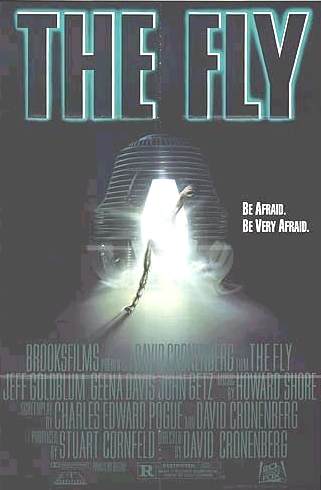
 The story is simple enough: Seth Brundle (Jeff Goldblum) is a genius physicist who has created a way to transport matter. Geena Davis plays Veronica, a reporter who is looking for an exclusive on Brundle's invention. Fearful that his secret will leak to the scientific community (which will cost him thousands) Brundle pursues Veronica at her office and pleads with her to not write the story until he has everything working for certain. Thus begins their relationship which soon blossoms into a romance. Veronica is just getting out of a relationship with her pretentious, yet caring, editor Stathis (played by the always smarmy John Getz) who is immediately jealous of the Veronica hangs on every word Brundle says. This was probably his affect on her sometime in the past. One night Veronica leaves Brudle's place to finalize some things with Stathis, however, Brundle too is weary of why she must leave and gets drunk, which leads to "something going wrong in the lab. Very wrong." You know the rest of the story from there.
 Yet, through all of the grotesqueness, Veronica still loves Brundle. And for all of the grotesqueness, the audience is still emotionally invested in the story; that is the triumph of The Fly and what Cronenberg is able to accomplish. Also, Cronenberg is able to conjure up suspense by element of surprise; we are never quite sure, once Brundle's metamorphosis takes place, what he is going to look like, or bad it's going to be. By keeping the audience guessing, the film does have a true horror genre feel to it, but it transcends the genre and cuts through the grotesque appearance of Brundle by maintaining the human element; the love Veronica has for Brundle, and him wanting her to remember him as he was, not what he is becoming.
 I wrote all of this with a bias as the driving force. There is something deep and profound and moving about this film that affects me so much. I haven't even mentioned that when we get to see the Brundle Fly at the end of the film, it is truly one of the scariest moments in horror. The final moments of the film are scary, no doubt, and if you haven't seen the film, and are not a fan of the usual stab and slash type of horror film, then rent The Fly. It's a brilliantly crafted, sophisticated horror film.


